...but the flesh was weak. I was all geared up to do a stint in the Snow Plow Sam suit at a brand new ice rink opening this weekend at Canal Park in Washington, DC but the weight of the thing was my undoing. Daughter is the skating director and to promote their fledgling USFSA Basic Skills Learn to Skate program, she had to recruit someone who was not only not afraid to make a giant fool out of their self but who could also skate in a 25 pound costume with the equivalent of a bowling ball on their head. I really enjoyed my 2 hours of glory, skating and waving until the noonday sun created a sauna in the suit that made me cry uncle. That Calorimetry I had so hastily fashioned to keep my ears warm was not necessary nor were any of the other items of clothing I had on underneath. The next time you run into such a creature, offer them your sincerest admiration because let me tell you, it is HARD work.
I get to do this again in a few weeks at her other rink in Georgetown so I need to get in shape. If you are in southern Maryland and you see this guy running down the street-it will probably be me.
Sunday, November 18, 2012
Saturday, November 17, 2012
Late to the Party
I never understood all the fuss about those fancy schmancy stitch markers. I tried them once with a lace project and it wasn't pretty. Last year at MDSW I made a bunch to offer up as a trade and then felt guilty about probably ruining someone's project with my clumsy construction. This morning after chasing around several errant round rubber markers that just popped off, in desperation, I dug out my little container of fancy markers and gave them another try. I am in love. They do work-on smooth worsted weight. They don't pop off and even if you drop them, you can find them since they can't roll away. The fact that they are so pretty and that I made them, only seals the deal. I'm hooked.
There is a HUGE story attached to this project btw. More on it later!
Friday, November 16, 2012
Proceeding With Caution
I have a history with sleeves. I am not very good at making them fit. They are always too long and too wide so making sure that the Lillehammer has sleeves that don't have to be reworked is very stressful. To make matters worse, there are increases that have to made in the colorwork pattern that are not charted out for you. They just assume that you can figure out how to do this on your own. I also should mention there is steeking involved. I should have used this post for Halloween because this is all pretty scary stuff.
Thursday, November 15, 2012
In Season
Daddio's Christmas craze has run its course so now we are back tracking to the fall holidays.
Thank goodness. After making five table runners, I don't want to see another reindeer and I can't tell you how sick I am of red and green.
While ordering all the winter holiday fabric, I fell in love with the Maple Skies collection from Connecting Threads and convinced Daddio to fill up a bucket of paper pieces for me. I can't tell you how happy I am to finally be working on something that will be mine!
Thank goodness. After making five table runners, I don't want to see another reindeer and I can't tell you how sick I am of red and green.
While ordering all the winter holiday fabric, I fell in love with the Maple Skies collection from Connecting Threads and convinced Daddio to fill up a bucket of paper pieces for me. I can't tell you how happy I am to finally be working on something that will be mine!
Wednesday, November 14, 2012
Everything You Ever Wanted to Know About Sox Part 2
Yesterday we knit down the leg and today we have to figure out what to do about the heel. Here is where the beauty of the Magic Loop really becomes apparent.
With 3 needles you have to figure out where things such as where the instep and the heel flap go and then you have to readjust your stitches-which for a beginner can be a nightmare.
With the Magic Loop, they are already lined up. The instep, which is the top of the foot is already all on the front needle. The stitches already on the back needle is where you will do all of your heel shaping. Brilliant.
All of the heel shaping begins with a simple heel flap. Imagine a square continuation of the stitches only on the back needle that is no longer in ribbing. The front needle is now being completely ignored while I knit back and forth on all the stitches on the back needle to build a square base onto which we will attach more things later.
For now I just knit 24 rows of slip1, knit1 on the front side and purl back on the reverse side-which will be on the inside of the sock. I always slip the first stitch of each row, even on the purl side. I just count the larger slipped stitches, when I get a length of 12, I am done. Remember, you don't do anything to the stitches on the other needle.
Then comes the fun part. When I have my flap done, I have to build a little round place to put my heel. I do this by using short rows. On the front side of the flap (the outside of the sock), I switch to regular old stockinette stitch which means knit on the front side and purl on the back ( the inside of the sock). I start by knitting to the center of the flap, which is to stitch number 14. Now I knit 2 more. Now I slip one, then knit one and pass the slipped stitch over the knitted one and then I knit 1 more stitch. I turn the work around not worrying a bit about the ones I didn't do. They are not going anywhere. After turning the work, I slip the first stitch, purl 5 more and then purl 2 together and turn the work again. Now there is no more counting. I just knit to the "hole" the turning makes and slip the one in front of it and then I knit the one after it and pass it over and knit one more and turn. Same thing with the purl side. I knit up to the "hole", then I purl the stitch in front of the hole with the one behind the hole together and then I purl 1 more and turn. I keep doing this until there are no more "holes". The heel flap now ends with a rounded top and lots fewer stitches. We have to do something about that.
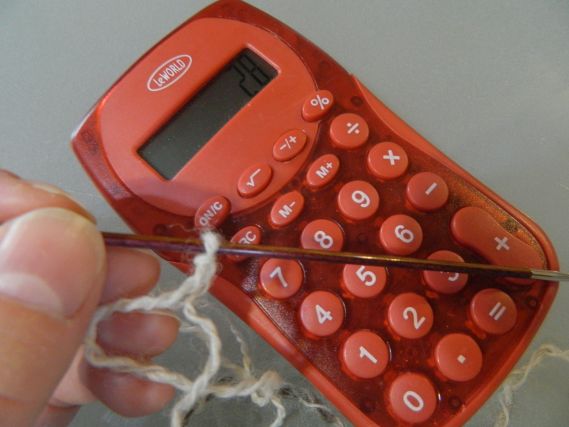
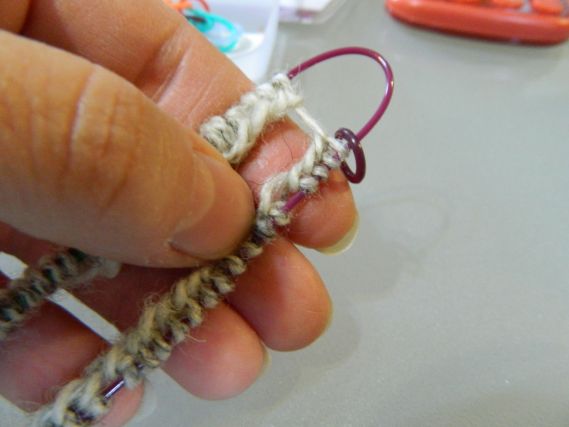
That flap has to be joined back to the stitches on the front needle that have been sitting there doing nothing. The problem is that I have used up lots of my original stitches and now I have to create a little "patch" on each side to join the front to the back. Those "patches" are called your heel gussets. It is the area I am pointing to that makes a neat little triangle on each side. The triangle comes from decreasing the stitches I am about to pick up.
If you look on each side of the heel flap you will see a nice neat row of stitches made by the stitches I slipped. There should be about 12 give or take a few. Being off a stitch or two here doesn't matter at all. I will be decreasing soon and I will be able to make up the difference.
Now to pick up stitches for the heel gusset, I want to stick my working needle through each slipped stitch and pull up a loop from the yarn in back all the way down the length of the flap. If this is too hard, I use a small crochet hook. I always keep one in my sock bag as some yarns can be tricky to pick up. If I have to add an extra stitch at the end to hide a hole at the join with the instep stitches- I do it. I can decrease it later and no one will know the difference.
I do this on both sides of the instep by first going down one side. When I come to the end of those picked up stitches I must switch needles again to knit across the instep. The instep must always be knit on its own needle so now I turn the needles to the right and pull out the heel needle. I knit the instep in the same way I did the leg ribbing. I am now going back to knitting around in a circle again-only this time it is the foot I am going around. When I am through with the instep, I switch the needle again by turning the the work to the right and pulling the back one through. Then I pick up the other side of the heel flap like I did the first side. If I did this right, I get way too many stitches on the back needle and all the original instep stitches will still be on their very own needle in the front of the sock. I can continue in ribbing for the instep or I can choose to switch over to stockinette here if I am tired of ribbing.
The good news is that I am now going to start decreasing most of those picked up stitches-every other row. I knit to 3 stitches before I switch to the instep needle and then decrease by knitting 2 together finishing with a knit 1. I knit across the instep needle and when I start the next side, I knit1 and then decrease again by slipping one and then knitting one and then passing the slipped stitch over the knitted one. As I said before, I do this every other row. When I get back to my original 28 stitches, I stop decreasing and then knit the foot as long as I need it to be. I usually stop when the foot gets to the bottom of my big toe. Another good thing about Magic Loop is that you can try it on at anytime. Just pull it all onto the cables and stick your foot in. Here is another terrible video of me working my way across the heel, decreasing and then going onto the instep.
When the foot is the right length, I start decreasing again just like I did before BUT this time I do it on both needles. Starting with the instep, I knit 1, slip1, knit 1 then pass the slipped one over. I then knit across to the last 3 stitches and knit 2 together and then finish by knitting one. I decrease the heel needle the same way as I did before. I do this to both needles on every other row. When I get to 28 stitches TOTAL, I start decreasing on EVERY row. That will keep me from getting a pointy toe. When I get down to the last 8 stitches, cut off the yarn leaving a long length, thread it on a big needle and then pull it through the stitches going in the correct order and tighten off. I weave this end in good and tight. I don't want my toes popping through. If you are using a really heavy yarn, you will more than likely want to graft those toes but that is way beyond my abilities here. You Tube it. I do.
Speaking of You Tube, here is another very good tutorial on the Magic Loop from Knit Picks that is probably a lot more clear than my long winded explanation.
Having said all this, let me say that this is a very, very, very basic tutorial on making socks for beginners. There are about a zillion wonderful variations on everything I have talked about here-enough to keep you pretty busy for the rest of your life.
With 3 needles you have to figure out where things such as where the instep and the heel flap go and then you have to readjust your stitches-which for a beginner can be a nightmare.
With the Magic Loop, they are already lined up. The instep, which is the top of the foot is already all on the front needle. The stitches already on the back needle is where you will do all of your heel shaping. Brilliant.
For now I just knit 24 rows of slip1, knit1 on the front side and purl back on the reverse side-which will be on the inside of the sock. I always slip the first stitch of each row, even on the purl side. I just count the larger slipped stitches, when I get a length of 12, I am done. Remember, you don't do anything to the stitches on the other needle.
Then comes the fun part. When I have my flap done, I have to build a little round place to put my heel. I do this by using short rows. On the front side of the flap (the outside of the sock), I switch to regular old stockinette stitch which means knit on the front side and purl on the back ( the inside of the sock). I start by knitting to the center of the flap, which is to stitch number 14. Now I knit 2 more. Now I slip one, then knit one and pass the slipped stitch over the knitted one and then I knit 1 more stitch. I turn the work around not worrying a bit about the ones I didn't do. They are not going anywhere. After turning the work, I slip the first stitch, purl 5 more and then purl 2 together and turn the work again. Now there is no more counting. I just knit to the "hole" the turning makes and slip the one in front of it and then I knit the one after it and pass it over and knit one more and turn. Same thing with the purl side. I knit up to the "hole", then I purl the stitch in front of the hole with the one behind the hole together and then I purl 1 more and turn. I keep doing this until there are no more "holes". The heel flap now ends with a rounded top and lots fewer stitches. We have to do something about that.
That flap has to be joined back to the stitches on the front needle that have been sitting there doing nothing. The problem is that I have used up lots of my original stitches and now I have to create a little "patch" on each side to join the front to the back. Those "patches" are called your heel gussets. It is the area I am pointing to that makes a neat little triangle on each side. The triangle comes from decreasing the stitches I am about to pick up.
If you look on each side of the heel flap you will see a nice neat row of stitches made by the stitches I slipped. There should be about 12 give or take a few. Being off a stitch or two here doesn't matter at all. I will be decreasing soon and I will be able to make up the difference.
Now to pick up stitches for the heel gusset, I want to stick my working needle through each slipped stitch and pull up a loop from the yarn in back all the way down the length of the flap. If this is too hard, I use a small crochet hook. I always keep one in my sock bag as some yarns can be tricky to pick up. If I have to add an extra stitch at the end to hide a hole at the join with the instep stitches- I do it. I can decrease it later and no one will know the difference.
The good news is that I am now going to start decreasing most of those picked up stitches-every other row. I knit to 3 stitches before I switch to the instep needle and then decrease by knitting 2 together finishing with a knit 1. I knit across the instep needle and when I start the next side, I knit1 and then decrease again by slipping one and then knitting one and then passing the slipped stitch over the knitted one. As I said before, I do this every other row. When I get back to my original 28 stitches, I stop decreasing and then knit the foot as long as I need it to be. I usually stop when the foot gets to the bottom of my big toe. Another good thing about Magic Loop is that you can try it on at anytime. Just pull it all onto the cables and stick your foot in. Here is another terrible video of me working my way across the heel, decreasing and then going onto the instep.
When the foot is the right length, I start decreasing again just like I did before BUT this time I do it on both needles. Starting with the instep, I knit 1, slip1, knit 1 then pass the slipped one over. I then knit across to the last 3 stitches and knit 2 together and then finish by knitting one. I decrease the heel needle the same way as I did before. I do this to both needles on every other row. When I get to 28 stitches TOTAL, I start decreasing on EVERY row. That will keep me from getting a pointy toe. When I get down to the last 8 stitches, cut off the yarn leaving a long length, thread it on a big needle and then pull it through the stitches going in the correct order and tighten off. I weave this end in good and tight. I don't want my toes popping through. If you are using a really heavy yarn, you will more than likely want to graft those toes but that is way beyond my abilities here. You Tube it. I do.
Speaking of You Tube, here is another very good tutorial on the Magic Loop from Knit Picks that is probably a lot more clear than my long winded explanation.
Having said all this, let me say that this is a very, very, very basic tutorial on making socks for beginners. There are about a zillion wonderful variations on everything I have talked about here-enough to keep you pretty busy for the rest of your life.
Tuesday, November 13, 2012
Everything You Wanted to Know About Sox Part 1
I have a bunch of handspun socks all in various stages of being finished and two sisters who have been asking me to teach them how to make socks. Since I never see them, I thought I would put a few notes here so if and when they ever have the time, they'll have a little something to get them started. Those of you who are expert in sock making need not waste your time here. This is for complete beginners and it is only my humble opinion and as we all know, I rarely, if ever, know what I am talking about.
First, I think beginners should always start with the the Magic Loop-One at a Time method. It is so much easier than learning on fiddly double points. I usually use a size 1 in a 32-40 inch length with fingering weight yarn. Thicker yarn calls for larger needles, use a size 2 or 3 for sport weight socks. I am not too picky about sizing because the socks will most certainly end up fitting someone I know.
I wear a size 7-8 shoe so I cast on 56 stitches but not all at once.
I first cast on half of my stitches (28) and then place a marker. I finish by casting on the other half right after the marker.
Then I push all the stitches down onto the cable and then bend and pull out a loop of the cable where the marker is. That is the "magic" loop. If this is confusing watch this video. This is a great 7 part series that shows you everything in detail for a leg down sock. Don't begin with toe up. Trust me. Don't.
Now carefully and slowly, I push both ends back up towards the needles. I will have half the stitches on one needle and half on the other. I make sure the working yarn is coming from the back needle and snip off the leftover from the long tail cast on leaving just enough to weave in later. I always do this because it's a problem if you accidentally start knitting with it. Don't ask me how I know this.
First, I think beginners should always start with the the Magic Loop-One at a Time method. It is so much easier than learning on fiddly double points. I usually use a size 1 in a 32-40 inch length with fingering weight yarn. Thicker yarn calls for larger needles, use a size 2 or 3 for sport weight socks. I am not too picky about sizing because the socks will most certainly end up fitting someone I know.
I wear a size 7-8 shoe so I cast on 56 stitches but not all at once.
I first cast on half of my stitches (28) and then place a marker. I finish by casting on the other half right after the marker.
Then I push all the stitches down onto the cable and then bend and pull out a loop of the cable where the marker is. That is the "magic" loop. If this is confusing watch this video. This is a great 7 part series that shows you everything in detail for a leg down sock. Don't begin with toe up. Trust me. Don't.
Now carefully and slowly, I push both ends back up towards the needles. I will have half the stitches on one needle and half on the other. I make sure the working yarn is coming from the back needle and snip off the leftover from the long tail cast on leaving just enough to weave in later. I always do this because it's a problem if you accidentally start knitting with it. Don't ask me how I know this.
Before I start knitting, I make sure all of your "bumps" are pushed to the inside of the work. That way I won't accidentally get a twist. Twists are bad for socks. Don't ask me how I know this either.
Now we are going to start calling the needles by names. There is a front needle and a back needle. Remember that the back needle is the one that ALWAYS has the working yarn coming from it. If it doesn't, I switch the needles around until it does. In order to start knitting, I just slowly pull the BACK needle out leaving the stitches on the cable until it reaches the front needle and I am able to knit comfortably with it. This is scary at first. I practiced this part over and over with big yarn and big circular needles until I was comfortable enough to do it with the skinny stuff. If you haven't yet, go watch that video and this will all become very clear-awkward at first but clear.
It seems crazy, but all I have to do now is knit down the front needle as usual in the ribbing of my choice. Here I am using a 3x1 which means repeating 3 knit stitches and then 1 purl stitch. On 56 stitches, the math on that works out perfectly. That marker will fall out and disappear, probably under the couch. Don't worry about it. I don't need it anymore. Oh, and I always make sure the working yarn isn't wrapped over the back needle or I will get a loop I don't want. It should be coming straight out of that last stitch not coming from over it.
When I get to the end of the needle, the other side is joined.
All I do now is push the back stitches which are now on the back cable up onto their needle...
...and turn them around so that they are back in the original working position with the needles facing right and the working yarn in the BACK. The row that has not been knit yet should be in front now and the row just knit is in the back. I slowly pull that back needle out and start knitting down the front needle again. Here is a terrible video of me doing it.
The method is called the Magic Loop because as you can see there are loops at each end of the work. They are important as they keep the two sides separate and when it comes to the heel and toe shaping I need to know where each side is so I make sure I don't pull the needles through so hard that I pull the loops in. If I do, I just recount and pull a loop back through the stitches the same way that I originally made the loop.
As I come to the beginning of each row I snug up the yarn a bit to avoid a "ladder" of loose stitches going up the side. I do this by pinching the two needles tightly as I make the first stitch. Again I make sure the yarn is not looped over the last stitch on the back needle. If it is I will have a yarnover when I come back around again. If I do this, I just drop it off the needle and forget about it. If I knit it, I will have a hole and a loose stitch looks better than a hole.
The first few rows look like the dog's breakfast until I can start seeing the ribbing pattern emerge. I keep knitting back and forth (actually around and around) on the two needles until I get the leg ribbing as long as I want it. The more I knit, the easier it becomes because it starts to make more sense once I can see the pattern emerge.
We'll tackle the heel tomorrow.
Monday, November 12, 2012
Ten
I usually love to sit down and compose my silly little posts each day but today, I am struggling. A few days ago I gave myself the task of trying write something about my mom who left us ten years ago today. To be precise, it was 4:30, on a rainy Tuesday afternoon, in a tiny cubicle in Georgetown University Hospital, after a frighteningly brief battle with an evil and rare leukemia. She was only 66.
The first thing you have to know about her is that she loved the water. The Chesapeake Bay was the love of her life. She spent most of her day combing the shore for treasures that only she appreciated.
She collected anything that had to do with boats and light houses. Fishing rods and shark's teeth were part of the decor. Her house looked like a marine museum. The freezer was always full of blue fish and crab meat that she had caught and cleaned herself.
When she wasn't slopping around in the bay, she loved to play dominoes. She drug Daddio over against his will every Saturday night to drink beer, eat popcorn and listen to the Gypsy Kings while we screamed and yelled our way through a game or two. Daddio always went home mad and she usually went home the winner.
In spite of being a champion fisherwoman, she always had gorgeous, long, painted nails. She loved to pamper herself and I still have this little jar of goop that she gave me for my sad little bitten down stubs.
She was also an amazing cook. She made the world's best potato salad, bean soup, creamed chipped beef on toast and an amazing pumpkin pie that made its own crust. We have all tried to replicate her recipes and we have all failed. She gave me this brilliant colander set and Chinese spider years ago and I use them all the time but never on anything as good as she ever made.
She was not what you would call a girly girl but she knew her way around a sewing machine. We still have her sewing box with all her patterns and her large Simplicity Fashion News collection. That is my wedding dress pattern, by the way. Way back in the early 70's, she made my dress and my bridesmaid's dress. She made my wedding cake too.
She didn't leave behind much in the way of jewelry. Most of what we have are things that her mother left her. What I do have is an award she won for some physical endeavor in high school. She left high school at 16 because...well, because of me. My parents were teenagers, who in spite of all the odds, made a darn good life for their three little girls and remained devoted to each other for almost 50 years. She left us just a few months short of that milestone, a fact Daddio still struggles with.
Last but not least, I cherish the socks I made her that she obviously put to very good use. We have all slaved over projects that end up only seeing the inside of someone's dresser drawers but when I found these, I was tickled that she had found them so useful. They were one of the first pairs of socks I had ever made. I bought the materials in a kit back when the internet was only a baby from a supplier I no longer remember.
It's strange, the terribly simple things that make up a life.
Ten years. It's still hard to believe she's not just a phone call away.
The first thing you have to know about her is that she loved the water. The Chesapeake Bay was the love of her life. She spent most of her day combing the shore for treasures that only she appreciated.
When she wasn't slopping around in the bay, she loved to play dominoes. She drug Daddio over against his will every Saturday night to drink beer, eat popcorn and listen to the Gypsy Kings while we screamed and yelled our way through a game or two. Daddio always went home mad and she usually went home the winner.
In spite of being a champion fisherwoman, she always had gorgeous, long, painted nails. She loved to pamper herself and I still have this little jar of goop that she gave me for my sad little bitten down stubs.
She was also an amazing cook. She made the world's best potato salad, bean soup, creamed chipped beef on toast and an amazing pumpkin pie that made its own crust. We have all tried to replicate her recipes and we have all failed. She gave me this brilliant colander set and Chinese spider years ago and I use them all the time but never on anything as good as she ever made.
She was not what you would call a girly girl but she knew her way around a sewing machine. We still have her sewing box with all her patterns and her large Simplicity Fashion News collection. That is my wedding dress pattern, by the way. Way back in the early 70's, she made my dress and my bridesmaid's dress. She made my wedding cake too.
She didn't leave behind much in the way of jewelry. Most of what we have are things that her mother left her. What I do have is an award she won for some physical endeavor in high school. She left high school at 16 because...well, because of me. My parents were teenagers, who in spite of all the odds, made a darn good life for their three little girls and remained devoted to each other for almost 50 years. She left us just a few months short of that milestone, a fact Daddio still struggles with.
Last but not least, I cherish the socks I made her that she obviously put to very good use. We have all slaved over projects that end up only seeing the inside of someone's dresser drawers but when I found these, I was tickled that she had found them so useful. They were one of the first pairs of socks I had ever made. I bought the materials in a kit back when the internet was only a baby from a supplier I no longer remember.
It's strange, the terribly simple things that make up a life.
Ten years. It's still hard to believe she's not just a phone call away.
Subscribe to:
Comments (Atom)